
High sensitivity
Typical change in resistance is on the order of -3% to -6% per °C, giving stronger signal response than many other sensor types.
Technical Information

NTC thermistors are among the most sensitive temperature sensing devices in general use for temperature measurement, control, indication, and compensation from -50 °C to +150 °C.
Typical change in resistance is on the order of -3% to -6% per °C, giving stronger signal response than many other sensor types.
The resistance / temperature characteristic is non-linear, predictable, and commonly specified by curve plus the resistance at 25 °C.
NTC thermistors are available as leadless chips, leaded devices, probe assemblies, and custom multi-sensor designs.
NTC thermistors are among the most sensitive temperature sensing devices in general use for temperature measurement, control, indication, and compensation across practical operating spans from -50 °C to +150 °C.
A thermistor is composed of a semiconducting material that behaves like a thermally sensitive resistor. Its primary function is to exhibit a change in resistance when its body temperature changes because of ambient temperature shifts or current-induced self-heating. By measuring the resistance of a thermistor in a non-self-heating mode, its temperature and the temperature of the surrounding medium can be determined accurately.
In some applications, thermistors are deliberately self-heated by an electrical current under controlled conditions. In that mode, a self-heated thermistor can be used to measure the flow of gases or liquids.
NTC thermistors, or negative temperature coefficient thermistors, decrease in electrical resistance as body temperature increases. PTC thermistors, or positive temperature coefficient thermistors, behave in the opposite way and increase in resistance as temperature rises.
North Star Sensors specializes in manufacturing precision NTC thermistors from basic raw materials through finished products, with each production step closely monitored and controlled.
The thermally sensitive material in an NTC thermistor is composed of tightly packed and sintered grains of metal oxides such as manganese oxide, nickel oxide, iron oxide, and copper oxide. These solid structures are semiconductive to electricity. As temperature rises, electrons have a greater chance of occupying the conductive energy band of the material, so electrical conductivity increases and resistance decreases. Conversely, when body temperature falls, resistance increases.
The resistance / temperature characteristic of an NTC thermistor is non-linear, predictable, repeatable, and can be reproduced to exacting specifications. Because this characteristic is non-linear, NTC thermistors are commonly defined by their R/T curve.
The resistance value of an NTC thermistor is typically referenced at 25 °C, abbreviated as R25. The most common R25 values used for NTC thermistor applications range from 100 ohms to 100,000 ohms, although values as low as 50 ohms and as high as 1 megohm can also be produced. Custom NTC thermistors can also be specified with resistance values point-matched at temperature points other than 25 °C.
Each thermistor composition, or mix, has a specific ratio of metal oxides that helps define the thermistor’s physical dimensions, its R/T curve characteristics, and its resistance at 25 °C. NTC thermistors typically exhibit a relatively large change in resistance versus temperature, on the order of -3% to -6% per °C, providing substantially greater sensitivity to temperature change than thermocouples and RTDs.
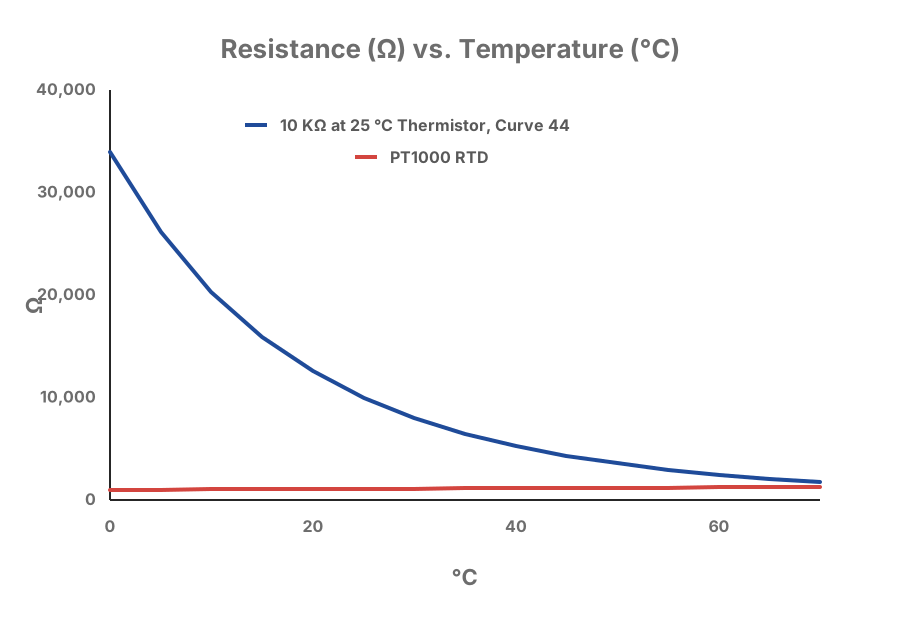
NTC thermistors are widely used because they are available in a broad range of physical configurations, including leadless thermistors, leaded thermistors, and temperature probe assemblies.
Besides standard thermistor probe and assembly configurations, North Star Sensors can build custom NTC thermistor products to meet unique application requirements. When needed, other sensor technologies can also be incorporated into a probe design, including custom RTD and thermocouple assemblies.