
Dissipation constant
The dissipation constant expresses how much power changes thermistor temperature under stated reference conditions.
Technical Information
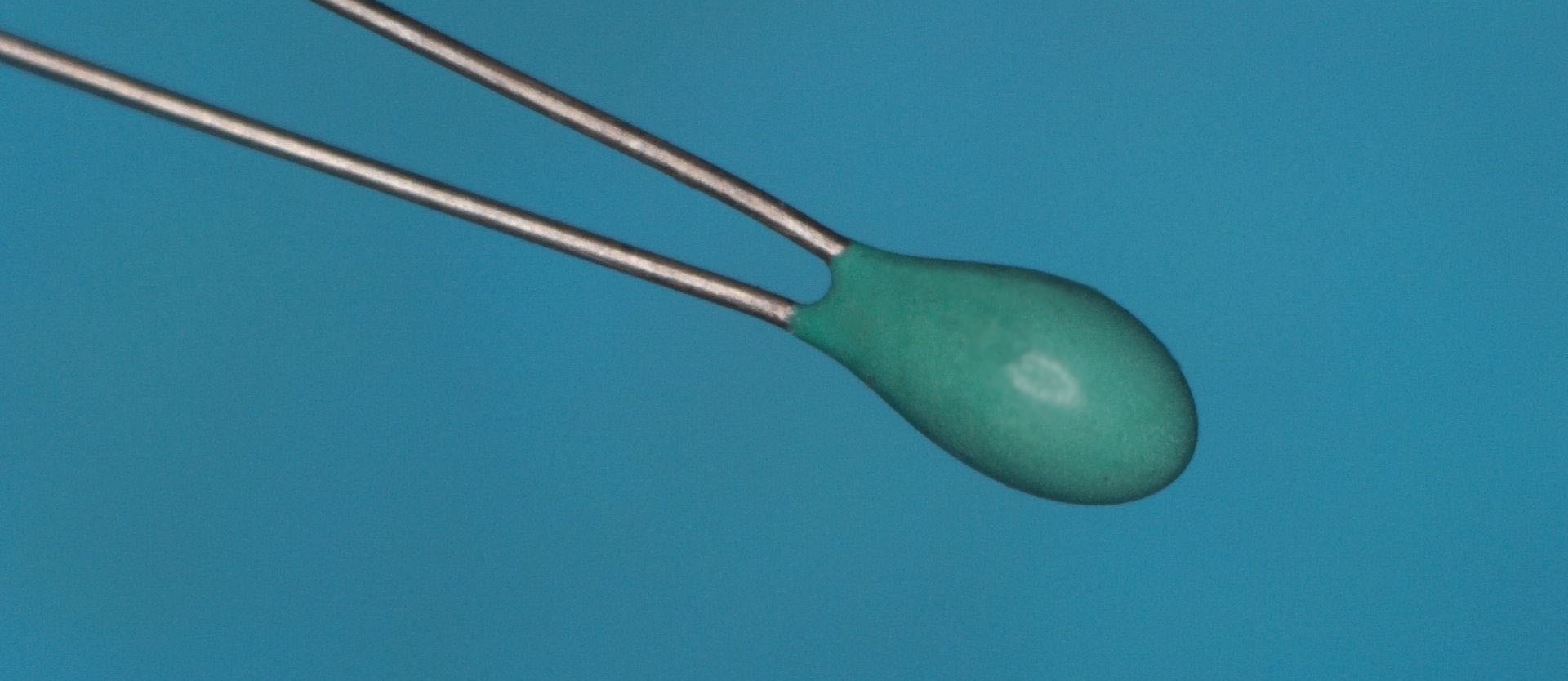
Thermistor performance is shaped not only by the R/T curve, but also by self-heating behavior, dissipation, allowable applied power, and response time.
The dissipation constant expresses how much power changes thermistor temperature under stated reference conditions.
A simple dissipation-constant estimate helps limit self-heating and supports essentially zero-power measurements.
Published time constant values are reference data only and change with housing, medium, and field conditions.
Beyond the R/T curve itself, two of the most application-dependent thermistor specifications are dissipation constant and time constant. Both are usually published from controlled laboratory conditions and should be treated as reference data when evaluating real-world sensor performance.
The dissipation constant (δ) of a thermistor, expressed in units of milliwatts per degree Celsius (mW / °C), is defined as the ratio, at a specified ambient temperature, of a change in power dissipation to the resulting change in the thermistor body temperature. Published values are typically based on a thermistor immersed in a temperature-controlled oil bath or suspended by its leads in still air under equilibrium conditions.
These values are reference data only. The dissipation constant is not a true constant because it changes with encapsulation or housing style, thermistor temperature, mounting method, and the medium being measured. For that reason, it is also commonly described as a dissipation factor.
North Star Sensors recommends keeping the self-heat error to less than one quarter to one tenth of the desired measurement accuracy.
δ (mW / °C) x Temp. Tol. (°C) x 0.1 = Maximum applied power
For example, a thermistor with a temperature tolerance of ± 0.2 °C and a dissipation constant of 1 mW / °C has a maximum applied power of 0.02 mW.
Generally speaking, to minimize or eliminate self-heating effects and perform essentially zero-power measurements, the excitation current should be kept in the 10 to 50 microamp range.
Several factors affect a thermistor’s ability to dissipate power:
Therefore, careful consideration of all these parameters is necessary to eliminate or at least minimize the effects of self-heat errors for temperature measurement applications.
For thermistors with, or connected to, a relatively large thermal mass such as a housing, it is sometimes possible to pulse the excitation current in the 250 microamp range for a few milliseconds and then allow the heat to dissipate for a few hundred milliseconds before the next measurement pulse.
That pulsed approach does not work well for micro-thermistors with relatively low thermal mass, where even a few milliseconds can produce discernible self-heating during the measurement pulse. In those cases, it is better to keep the excitation current in the 10 microamp range.
The time constant (τ) is the time required for a thermistor to register a temperature change equal to 63.2% of the total difference between its initial and final body temperature when subjected to a step change in temperature under zero-power conditions.
Published time constant values are typically given for a thermistor immersed in a well-stirred, temperature-controlled oil bath or suspended by its leads in still air under equilibrium conditions. These values are reference data only because the time constant of a thermistor or thermistor probe depends on the thermal properties of the materials, the media being tested, and the temperatures being measured.
If response time matters in the application, the thermistor or thermistor probe should be measured in a test environment that closely resembles field conditions.
To determine the time constant of a thermistor, its resistance must be known at three temperatures: a low temperature point, a high temperature point, and a mid-temperature point equal to 63.2% of the difference between the high and low temperatures.