
Interchangeable tolerance
Temperature tolerances are expressed over a defined temperature range so parts can be used interchangeably.
Technical Information
Thermistor tolerance should be specified around the temperature range that actually matters for the application.
Temperature tolerances are expressed over a defined temperature range so parts can be used interchangeably.
Point-matched parts are specified at a single temperature, typically 25 degrees C, and require adders to estimate tolerance elsewhere.
Overall system accuracy is the sum of thermistor tolerance and monitoring system tolerance.
When designing a product that uses thermistors, it is important to determine the broadest temperature tolerance and the minimum temperature range where precision is required. A medical product, for example, may need very tight accuracy over a narrow operating band, while equipment monitoring may tolerate a broader accuracy window over a wider range.
Interchangeable NTC thermistor temperature tolerances are specified as a temperature tolerance over a temperature range. For example, North Star Sensors lists a T1A temperature tolerance as accurate within ± 0.1 °C over the temperature range of 0 °C to 70 °C. These parts are considered interchangeable because one thermistor can replace another within that tolerance without calibrating each part individually.
Temperature tolerances can range from ± 0.05 °C to ± 2.0 °C, and the supported temperature range can extend from -40 °C to 150 °C. The right specification depends on where the application actually needs precision. A medical device may only need ± 0.05 °C accuracy from 34 °C to 40 °C, while a monitoring application may work well with ± 0.5 °C from 0 °C to 70 °C. Tightening the tolerance beyond the real need adds cost without improving the result.
Overall system accuracy should also be considered. System accuracy is the sum of thermistor tolerance and monitoring-system tolerance. As an example, a thermistor tolerance of ± 0.1 °C paired with a monitoring-system accuracy of ± 0.05 °C yields an overall system accuracy of ± 0.15 °C.
Point-matched thermistors are specified as a percent resistance tolerance at a single temperature point, typically 25 °C. To estimate the percent resistance tolerance at another temperature, add the manufacturing tolerance adder for that curve and temperature to the specified point-matched tolerance.
For example, a Curve 44 thermistor with a ± 1% resistance tolerance at 25 °C uses a ± 3% manufacturing tolerance adder at 100 °C. That results in a total resistance tolerance of ± 4% at 100 °C.
North Star Sensors publishes manufacturing tolerance adders in 5 °C increments for each curve on the Temperature Curves page.
The Temperature Curves page also includes 1 °C tables with resistance ratios and NTC values for each curve. To determine thermistor resistance at a temperature other than 25 °C, multiply the listed ratio by the resistance at 25 °C.
North Star Sensors states that its thermistors are manufactured using standards whose calibrations are traceable to the National Institute of Standards and Technology (NIST) or derived from ITS-90 fixed points, including the triple point of mercury (TPHg), triple point of water (TPH2O), melting point of gallium (MPGa), freezing point of tin (FPSn), and freezing point of zinc (FPZn).
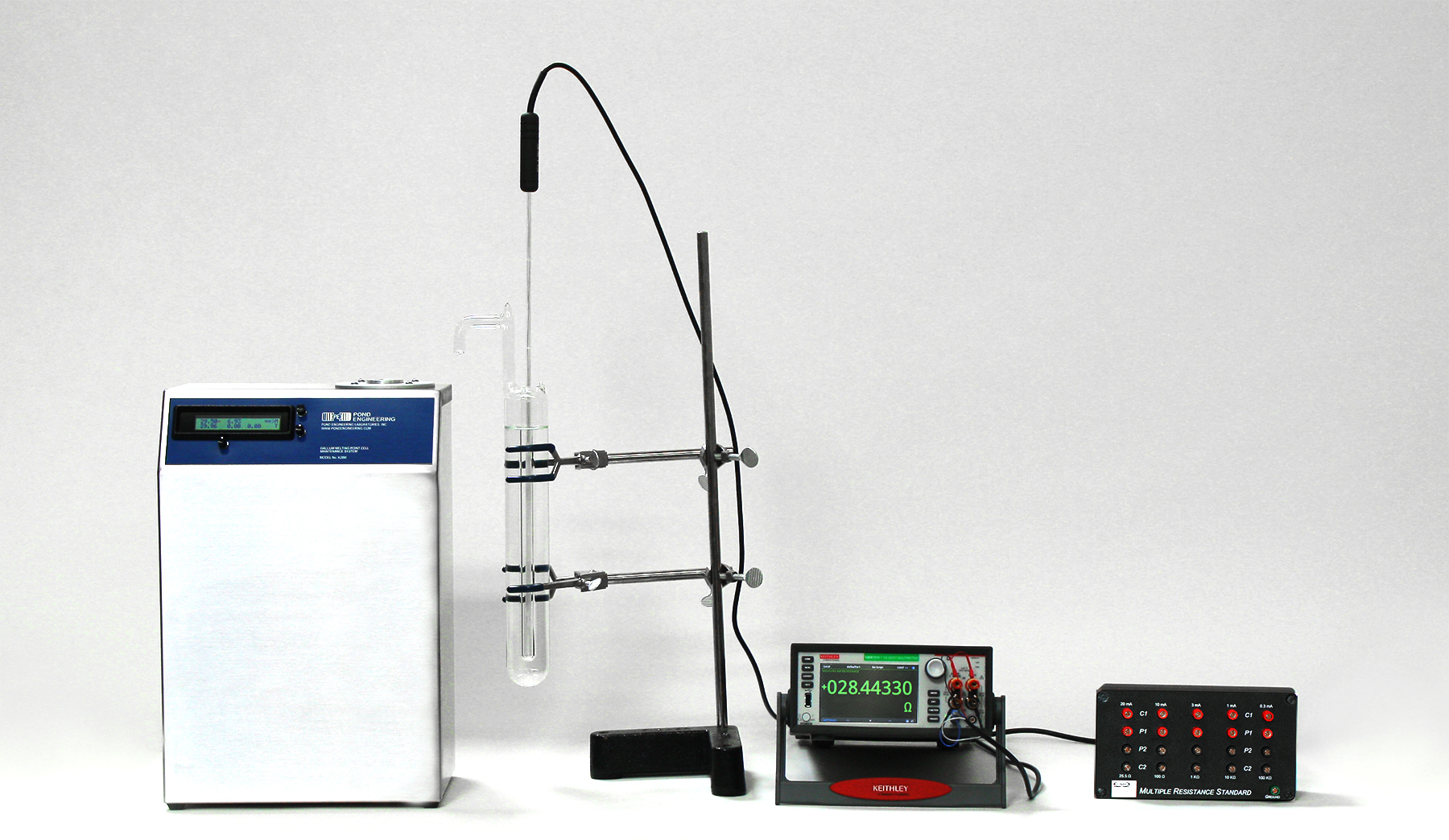
In house, North Star Sensors maintains a triple point of water cell, a melting point of gallium system, an SPRT, and a set of fixed resistance standards.
The triple point of water cell is the same type of temperature standard used by NIST to calibrate standard platinum resistance thermometers and other thermometers that require very low uncertainty. The triple point of water is a defining ITS-90 temperature point with a value of 0.01 °C and an uncertainty of + 0.00000 °C / - 0.00015 °C.
The melting point of gallium system provides another ITS-90 defining temperature point with a value of 29.7646 °C and an uncertainty of ± 0.001 °C.
The standard platinum resistance thermometer (SPRT) used by North Star Sensors is calibrated by a nationally recognized metrology laboratory and verified with in-house TPH2O and MPGa standards. North Star Sensors lists the expanded uncertainty, U, of its primary SPRT calibration system as ± 0.003 °C with a coverage factor of k = 2.
North Star Sensors also states that its super-stable temperature probes are used as secondary standards to calibrate production temperature-controlled baths to an expanded uncertainty of ± 0.01 °C. Its resistance standards have expanded uncertainties of ± 2 ppm and are used to calibrate resistance measuring instruments to an expanded uncertainty of ± 0.02%, which corresponds to an equivalent temperature expanded uncertainty of ± 0.007 °C.
Based on those standards, North Star Sensors lists the total expanded uncertainty of the test and measurement system used to manufacture thermistors as ± 0.012 °C, traceable to NIST.
Note: Each expanded uncertainty listed here is described by North Star Sensors as the combined standard uncertainty multiplied by a coverage factor of k = 2, following NIST guidance.